27
Jun
Is an Air Source Heat Pump Right for Your Home?
An air source heat pump suits most homes that are reasonably well insulated, have space outside for the unit and inside for a hot water cylinder, and can have radiators big enough to heat each room at a lower water temperature. It's often a strong fit for homes off the gas grid. A survey tells you for certain, and it also shows what, if anything, needs changing first.
This guide explains how a heat pump works, what makes a home suitable and what the survey involves. If you already know you want one, see our heat pump installation page.
How an air source heat pump works
A heat pump works like a fridge in reverse. A fridge takes heat out of the cabinet and releases it at the back. A heat pump takes heat out of the outside air and releases it into your heating and hot water.
- A fan draws outside air through the outdoor unit.
- A refrigerant inside the unit absorbs heat from that air, even when it's well below freezing.
- A compressor raises the temperature of the refrigerant.
- That heat passes into the water that runs to your radiators or underfloor heating, and to your hot water cylinder.
The electricity runs the fan, compressor and pumps. It moves heat rather than making it, which is why a heat pump is efficient. The water it sends round the house is cooler than a boiler's, so a heat pump runs for longer, more steadily. Rooms stay at an even temperature rather than heating up fast and cooling down.
Which homes suit a heat pump
A home doesn't need to be a new build. We fit heat pumps in stone cottages, terraces and older houses as well. What matters is that the system is designed around how the home loses heat. These are the four things we look at.
Insulation and heat loss
The less heat a home loses, the smaller the heat pump it needs and the easier it is to keep warm at a low water temperature. Loft insulation, cavity wall insulation where the walls allow it, and fixing draughts all help. They're worth doing first if they're quick wins. A home doesn't have to be perfectly insulated. It does need a heat pump sized for the heat it actually loses.
Radiators or underfloor heating
Because the water is cooler, some rooms may need a larger radiator to stay warm. That doesn't mean replacing every radiator. The heat loss survey works out each room, so you only change the ones that need it. Underfloor heating suits a heat pump well, as it's designed to run at low temperatures.
Space for the outdoor unit
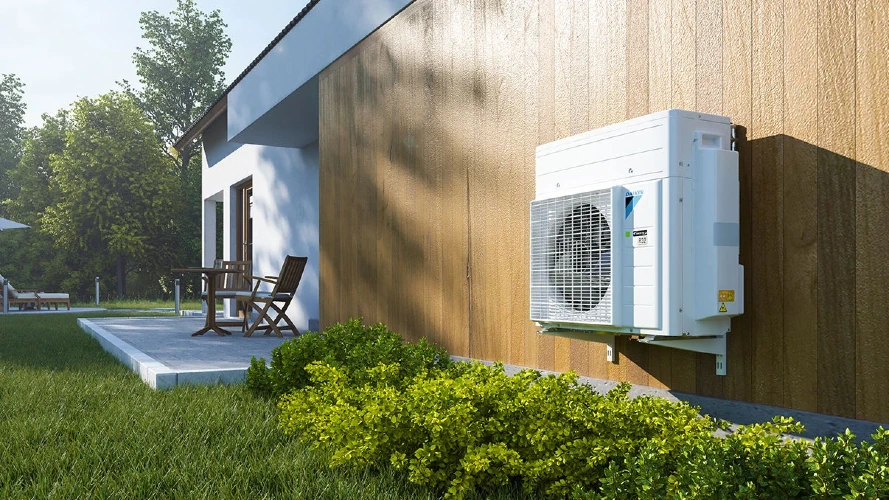
The outdoor unit sits on the ground or on a wall bracket, with open space around it for air to flow. It needs a route for pipework into the house and somewhere for water to drain away when it defrosts in winter. We check where it can go at the survey.
Space for a hot water cylinder
A heat pump heats a tank of stored hot water rather than heating it on demand like a combi boiler. If you have an airing cupboard with a cylinder, it can usually be replaced with one designed for a heat pump. If you have a combi boiler, you'll need to find room for one. This is often the deciding question in smaller homes.
Off the gas grid: replacing oil, LPG or storage heaters
Many of our customers in rural North Yorkshire, Northumberland and the Durham Dales are off the gas grid. A heat pump means no more oil or LPG deliveries, no tank to look after and no boiler flue.
- Oil and LPG boilers already have radiators and pipework, so the change is usually the heat source, the cylinder and any radiators that need upsizing.
- Storage heaters and electric heating need a wet system fitting: radiators or underfloor heating and pipework. It's a bigger job, but it gives you controllable heating and hot water from one system.
Both count as replacing fossil fuel or electric heating for the Boiler Upgrade Scheme, which we cover below.
Hybrid systems: a heat pump with a boiler
A hybrid system pairs a heat pump with a boiler. The heat pump does most of the heating, and the boiler steps in during the coldest weather or for hot water when needed. It can suit a home where a heat pump on its own would mean replacing a lot of radiators, or where you want to keep a newer boiler.
We're Gas Safe registered as well as F-Gas registered, so one team installs and looks after both halves of a hybrid system. Grant rules differ for hybrids, so we confirm what applies at the survey.
The Boiler Upgrade Scheme grant
Most homes in England and Wales can get £7,500 towards an air source heat pump. The grant is for replacing fossil fuel or electric heating, and it must be claimed by an MCS certified installer. We're MCS certified, we check your eligibility at the survey and we take the grant off your quote.
The survey and design
A heat pump only works as well as it was designed. Too small, and it struggles on cold mornings. Too big, and it keeps switching on and off, wasting electricity and wearing out early. So every installation starts with a survey.
- Survey We measure each room, work out the heat loss and check your radiators, pipework, cylinder space and where the outdoor unit can go.
- Design and quote We size the heat pump, radiators and cylinder, and send a written quote that sets out exactly what's included.
- Installation We fit the outdoor unit, cylinder and controls, and upgrade any radiators that need it.
- Handover We set the system up for your home, show you how to use the controls and register it, so you get your MCS certificate.
The cost depends on the size of heat pump your home needs, how many radiators need changing and whether you need a new cylinder. The survey is how we work that out, so the quote is for your home rather than an average.
Running and servicing a heat pump
A heat pump runs best when it's left to run steadily. Rather than switching it on and off like a boiler, you let the controls hold an even temperature. Weather compensation adjusts the water temperature to the weather outside, and a lower water temperature generally means a more efficient system. We set this up at handover and show you how to use it.
Like a boiler, a heat pump needs a yearly service. Most manufacturers need one by a qualified engineer to keep the warranty valid, so check your warranty paperwork for what yours requires. Our heat pump servicing covers the outdoor unit, controls, water quality and cylinder, with a PDF report after every visit. Our heat pump service plans include the annual service, paid monthly or yearly, and our winter checklist covers what to do when the cold weather arrives.
Book a heat pump survey
We're MCS certified, a Daikin Approved Installer and RECC members, with more than 30 years' experience in refrigeration, air conditioning and heating. Our engineers work from ATE House in Carlin How, near Saltburn-by-the-Sea, and our office in Whitby, covering Tyne and Wear, Northumberland, County Durham, North Yorkshire and East Yorkshire.
To find out whether a heat pump suits your home, call 01287 281014 or 07931 908711, email info@ateservices.co.uk, or see our heat pump installation and repair page.